
Freedom Land Management handles the heavy first step on a property — taking overgrown, wooded, or unusable ground and getting it ready for whatever comes next. That covers traditional land clearing and forestry mulching, plus the excavation and demolition work that usually comes attached to it.
Everything below is done by the same owner-operator, on the same equipment, across Dickson, Williamson, Cheatham, Maury, Hickman, and Humphreys Counties. Estimates are free, and they’re based on walking your property rather than guessing at acreage from a map.
Traditional land clearing is the full removal approach: trees, stumps, brush, and undergrowth taken out and hauled off or piled, leaving open ground you can build on, farm, fence, or mow. It’s the right call when the land needs to be genuinely clear — a house site, a pasture, a shop pad, a new field.
This is the service most people are picturing when they call about a wooded lot they just bought.
Forestry mulching uses a mulching head to grind standing brush, saplings, and small trees down into a layer of mulch that stays on the ground where it fell. There’s no burning, no hauling, no debris piles to deal with afterward, and far less ground disturbance than traditional clearing.
It’s a strong fit for clearing underbrush out of a wooded lot you want to keep wooded, opening up trails and fence lines, taking back pasture that’s grown up, and improving overgrown property without stripping it down to dirt. It also works when the ground is too soft for heavier clearing methods.
Once the ground is clear, most projects need dirt work. Freedom Land Management handles general site preparation, grading, driveway cuts, house and shop pads, and underground utility work.
This is the service that quietly turns a cleared lot into a buildable one — getting the elevations right, moving water away from where you’re going to build, and putting in an access road that holds up.
Smaller-scale demolition — old houses, garages, sheds, and outbuildings that need to come down before anything new goes up. This is focused residential and light demolition work rather than large commercial teardowns, and it often runs together with clearing and site prep on the same property.
Like mulching and clearing, demolition doesn’t need dry ground to move forward, which makes it a practical winter and wet-season project.
Most jobs don’t stay in one category, and that’s usually a good thing for the property owner — one operator, one mobilization, one point of contact instead of scheduling three companies around each other.
Here’s how these services typically pair up:
If you’re not sure which service your property actually needs, that’s a normal question and it’s part of what the estimate is for. Sometimes mulching does everything you wanted for less than full clearing. Sometimes it doesn’t. You’ll get a straight answer either way.
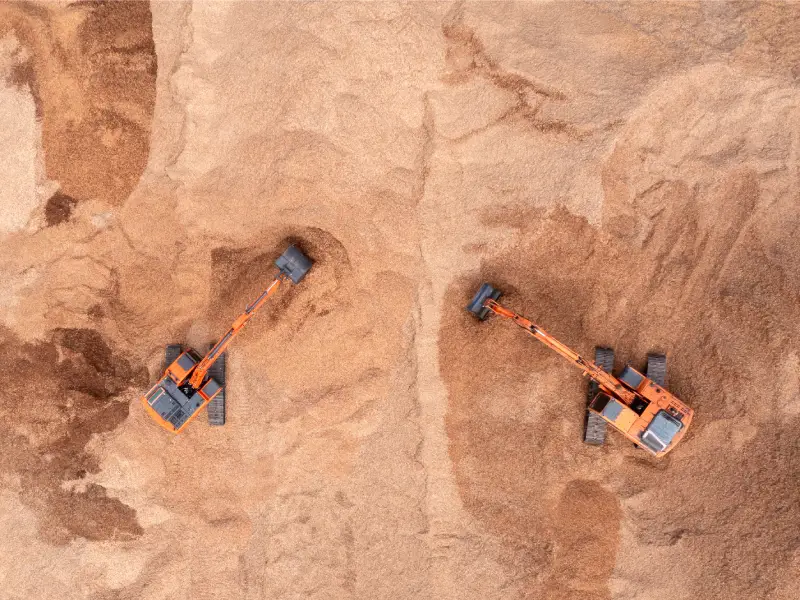
Freedom Land Management is based in Burns, TN and works within roughly 60 miles of it. Across Dickson County that covers Burns, White Bluff, Dickson, Charlotte, Vanleer, Cumberland Furnace, Slayden and Tennessee City. East along US-70 and I-40 we reach Kingston Springs, Pegram, Ashland City and Bellevue. West and south we take work in Fairview, Bon Aqua, Lyles, Nunnelly, Pinewood, Centerville, McEwen, Waverly and New Johnsonville.
In Williamson County we cover Franklin, Leiper’s Fork, College Grove, Spring Hill and Thompson’s Station. Ground conditions change across that radius – Highland Rim ridge lots sit on chert-heavy residuum that grubs and trenches slowly, while the Piney River and Jones Creek bottoms hold water and have a tighter working season. Any job disturbing an acre or more needs stormwater coverage under the state’s Construction General Permit through TDEC, which we handle rather than leaving on you. See every area we cover, or learn more about our crew.
Tell us what you’ve got — acreage, what’s growing on it, and what you’re trying to do with it. Estimates are free, and there’s no pressure attached.
It comes down to whether the roots have to leave the ground. If you are pouring footers, cutting a driveway, or putting in a septic field, the root balls have to come out and that is traditional land clearing. If the goal is visibility, pasture, trails or fence lines, forestry mulching does the same visual job for roughly half to two-thirds the cost and leaves a mulch mat behind doing erosion work. If the ground needs to sit at a specific elevation and drain, it is an excavation job. Sometimes mulching does everything you wanted for less than full clearing, and sometimes it does not – you will get a straight answer at the estimate either way.
Traditional land clearing in Tennessee generally runs about $1,300 to $4,500 per acre, with full grubbing at the top of that band. Forestry mulching generally runs $1,105 to $1,950 per acre. Residential demolition runs roughly $4 to $10 per square foot before foundation removal. Excavation is priced off how much dirt moves and what is under it rather than by area. We price density and site conditions, not acreage, which is why the on-site walk is free and not optional.
That is usually the cheaper way to do it. Land clearing plus excavation is the most common combination – clear the trees and stumps, then cut the driveway, shape the pad and set the grade so the site drains. Demolition plus clearing runs together when an old structure and the growth around it both have to go. Combining them means one equipment haul, one point of contact, and no gap where two contractors each assume the other handled the drainage.
Light brush on flat, accessible ground can be cleared and rough-graded in a day. An acre of mature hardwood with large root balls on slope, with debris that has to be hauled off, can run three to four days. A residential teardown is typically two to five days on site once utilities are verified dead and the 811 locate has cleared. You get a scheduled window at the estimate, not a vague promise.
Yes, and it is worth knowing. Land clearing, forestry mulching and demolition do not need dry, firm ground the way finish earthwork does, so your project does not sit idle every time there is a rainy stretch. Booking in the slower winter months usually gets you a better spot on the calendar than fighting for a slot in the spring backlog.