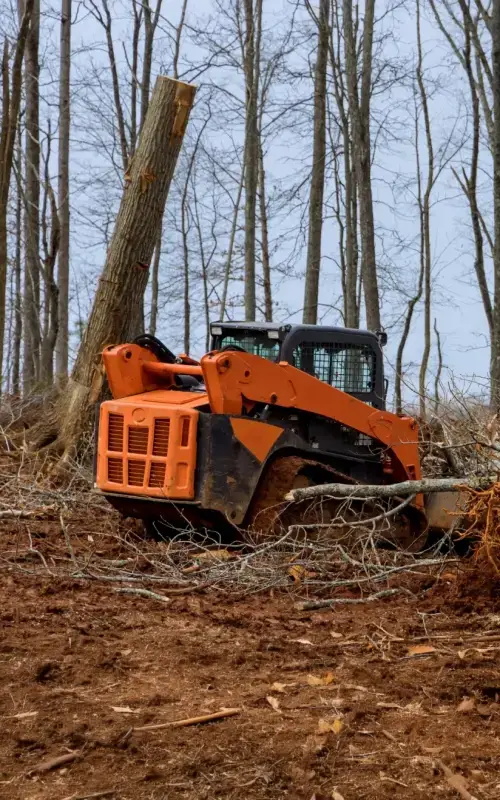
Forestry mulching grinds brush, vines, saplings, and smaller trees into a layer of mulch where they stand. It can be the right way to reclaim an overgrown pasture, open a wooded lot, or clean a fence line without hauling every piece away. It is not a shortcut to a building pad. The best method depends on what you want the ground to do next.
Freedom Land Management uses forestry mulching across Burns, Dickson County, and surrounding Middle Tennessee counties. This guide explains how the work functions, what affects the price, when mulching makes more sense than traditional land clearing, and what to plan for after the machine leaves. For a narrower seasonal angle, see the existing guide to forestry mulching before winter in Burns.
What is forestry mulching?
Forestry mulching is a land-clearing method that processes standing vegetation into mulch on site. A powered drum head with carbide-tipped teeth spins against brush and small trees, reducing the material instead of pushing it into a pile or loading it for haul-off.
The finished ground is not a lawn and it is not the same as a construction-ready site. It is a usable surface with a layer of woody material spread across it. That layer can help cover soil, slow runoff, and make an overgrown area easier to walk, mow, fence, seed, or inspect. The result depends on the vegetation, soil, slope, access, machine, and finish the property needs.
At the right site, forestry mulching can remove several steps from a clearing project:
- There is no debris pile to burn.
- There is no dump trailer for every load of brush.
- There is no landfill charge for material that stays on the property.
- Selected mature trees can remain when the operator has room to work around them.
- The ground receives cover as the brush is removed.
Those benefits do not mean every wooded acre should be mulched. If the next step is a footing, septic field, driveway, underground utility, or graded house pad, the roots and soil may need a different treatment.
Pro Tip: Tell the contractor what you plan to do with the property after the brush is gone. “Open the back field” calls for a different scope than “prepare a pad for a house.”
How the machine turns standing growth into usable ground
The cutting head is only one part of the result. The operator’s sequence matters just as much. Freedom Land Management describes its setup as a drum-style forestry mulching head with carbide-tipped teeth mounted on a high-flow compact track loader.
The drum head
A drum head carries rows of teeth across a rotating cylinder. The operator feeds woody growth into the drum and controls how much time the head spends on each stem, stump, or heavy patch. A head of this type can process brush and many smaller trees in one pass. The site describes its working capacity as roughly six to eight inches for a single pass, with larger stems taking more time or requiring another method first.
That capacity is a practical limit, not a promise that every six-inch tree will take the same effort. Species, moisture, branching, slope, access, and the desired finish all change production. Dense cedar mixed with privet is a different job from light brush under two inches.
The mulch layer
The processed material is left across the work area. A typical finished depth may be around two to four inches, although the actual result varies with the amount of growth and the number of passes. Good work spreads the material instead of leaving heavy windrows that block drainage or make mowing difficult.
The mulch layer can protect the soil from direct rain impact and reduce exposed bare ground. It does not replace every erosion-control measure. Slopes, drainage paths, creek buffers, and larger construction sites may need a separate stabilization plan.
The below-grade limit
Forestry mulching focuses on vegetation above the soil surface. The head can grind some stumps near grade, but it does not automatically remove every root ball, buried obstruction, or unsuitable layer of soil. That distinction is one of the most common sources of confusion.
A property can look open after mulching and still need excavation or grubbing before construction. If a driveway must be cut, a septic area prepared, or a foundation placed, the contractor should price that next phase rather than treating the mulch pass as the finished site.
Did You Know: A clean-looking mulched surface and a construction-ready building site are two different deliverables. The difference is what happens below grade and how the finished elevation drains.
What happens during a forestry mulching project?
A careful project starts before the machine arrives. The walk-through is where the scope, access, keep areas, and finish are decided.
1. Walk the property and define the goal
The first question is not “How many acres?” It is “What should this ground be used for when the work is done?” The answer may be a pasture, trail, homesite, hunting access, fence line, view corridor, or simple reclamation of land that has become hard to enter.
The walk should identify vegetation density, tree size, wet spots, steep areas, gates, overhead clearance, and the route the machine will use. Two five-acre properties can have very different prices if one has light brush and a firm entrance while the other has dense timber, a narrow access lane, and a soft low area.
2. Mark what stays
Trees, fences, property pins, septic areas, wells, structures, utility routes, and neighboring boundaries need attention before the head turns. Mature trees near a home may be kept. A fence line may be cleared while a shade tree remains. A property pin may be invisible under brush and still control the work limit.
The operator should also discuss material that cannot be seen clearly during the first visit. Buried wire, old trash, loose metal, and abandoned fencing can damage equipment and create a safety problem.
3. Open the work area in passes
Operators often begin by opening sight lines and reducing lighter understory. That exposes the heavier stems and makes the next passes more controlled. On a slope, the travel direction and machine position matter. The work plan should keep the machine stable and avoid pushing loose mulch into a drainage path.
The finish should match the use. A hunting trail may need a clean, passable route. A fence line may need room for posts and future maintenance. A pasture reclamation project may need enough light and access for seeding or grazing after the mulch settles.
4. Grind stumps within the machine’s capacity
Stumps that fit the head and the site plan may be ground near grade. Larger roots, buried stumps, and material near utilities may need to be handled separately. The estimate should say what the mulch pass includes and what it does not.
5. Walk the ground before leaving
The final walk-through checks the edges, access lane, mulch distribution, kept trees, and any soft or wet areas exposed during the work. It is also the time to identify follow-up work. A property may be ready for mowing, seeding, fencing, or trail use, or it may need grading or drainage work before the next phase.
Freedom Land Management’s public site describes an owner-operated process in which Josh Tant walks the property, reviews the scope, and operates the equipment on most jobs. The person giving the estimate is close to the work itself, which helps keep the density, keep areas, and finished-use discussion connected.
When does forestry mulching beat traditional land clearing?
Forestry mulching is often the better fit when the goal is to reclaim or open ground while leaving useful trees or natural cover in place. Traditional land clearing is often the better fit when the project needs the roots removed, debris hauled away, or the surface shaped for construction.
Mulching is a strong fit for these jobs
- Overgrown pasture and field reclamation
- Brush and sapling removal around a homesite
- Trail and access-road corridors
- Fence lines and property boundaries
- Selective opening beneath mature trees
- Visibility around an existing home or outbuilding
- Wooded areas that need usable ground without full bare-soil clearing
In each case, the next use still matters. A trail does not need the same finish as a driveway. A view corridor does not need the same below-grade preparation as a septic field.
Traditional clearing is usually better for these jobs
- A foundation or house pad
- A driveway that needs excavation and base preparation
- A septic area that must be shaped and stabilized
- A pasture that needs full root removal
- Land where all debris must leave the property
- Stump removal below the level needed for future construction
- Grading, drainage, cut-and-fill, or utility trenching
Freedom Land Management lists forestry mulching alongside traditional land clearing and excavation because the services answer different ground problems. Read the company’s land clearing service details when the project needs root removal, and review its excavation and site preparation service when dirt needs to move or elevations need to change.
A mixed scope can also be the right answer. One section may be mulched, another may be cleared, and only the driveway or building area may need excavation. Choosing one method for every acre can create extra cost or leave the next contractor with a harder site.
Pro Tip: Ask the estimate to separate “vegetation removed” from “ground prepared.” That simple distinction makes it easier to compare scopes from different contractors.
Forestry mulching in Burns and Middle Tennessee
Local ground changes the way a mulching project should be planned. Freedom Land Management is based in Burns, Tennessee, and serves Dickson, Williamson, Cheatham, Maury, Hickman, and Humphreys Counties within about 60 miles of Burns.
The Western Highland Rim includes silty surface soils over limestone residuum. In Dickson County, the Dickson soil series has a dense layer called a fragipan that can slow water movement below the surface. Middle Tennessee also receives substantial rainfall over the course of a year. Those conditions make access, slope, drainage, and the timing of exposed soil worth discussing before equipment arrives.
Mulching can help keep a cover layer on the ground, but it is not a license to ignore water. A work plan should protect the entrance, avoid sending material into a ditch or stream, and identify where runoff will go after a thick patch of vegetation is removed. Larger soil-disturbance projects may fall under Tennessee stormwater requirements. The Tennessee Department of Environment and Conservation NPDES resources are the proper starting point for checking applicable permit programs.
The company’s service area includes Burns, Dickson, White Bluff, Charlotte, Vanleer, Cumberland Furnace, Slayden, Kingston Springs, Pegram, Ashland City, Bellevue, Fairview, Bon Aqua, Lyles, Nunnelly, Pinewood, Centerville, McEwen, Waverly, New Johnsonville, Franklin, Leiper’s Fork, College Grove, Spring Hill, and Thompson’s Station. Exact availability depends on the property and the current schedule.
How much does forestry mulching cost per acre?
A planning range published in Freedom Land Management’s current service content is about $1,105 to $1,950 per acre for forestry mulching in Tennessee. That range is not a guaranteed quote. A second reference point in the same content is a day-rate range of about $2,600 to $4,000 when a project is priced around the machine, operator, fuel, and basic insurance.
The price moves because an acre is a measurement, not a workload. The main cost drivers are:
Vegetation density
Light brush and scattered saplings may move quickly. Dense cedar, privet, honeysuckle, vines, and larger stems require more passes and more time. The amount of material per acre matters more than the acreage number by itself.
Stem size and species mix
A stand of small flexible growth is different from hardwoods or cedars with larger trunks. Larger stems may need slower processing, felling first, or a different clearing method.
Slope and ground conditions
Steep ground affects machine speed and positioning. Wet areas can limit access and create a need for protective routing. A safe plan may require working around a soft section or scheduling after the entrance firms up.
Access and mobilization
The machine has to reach the work area, and the trailer has to reach the property. Narrow gates, long drives, low branches, soft entrances, and a long haul from Burns all affect the quote. Mobilization is a real job cost, not an afterthought.
What happens after mulching
If the customer needs seeding, grading, drainage, stump removal, haul-off, or a construction pad, those are separate tasks unless the quote says otherwise. A low mulching price is not a low complete-project price if the next phase is missing.
The fairest estimate is based on an on-site walk. Freedom Land Management’s free estimate page is the direct next step for a property-specific scope.
Did You Know: The same two-acre measurement can represent very different work. Density, access, slope, and the finished use usually tell more about the price than the deeded acreage alone.
How to compare forestry mulching estimates
A written estimate is easier to compare when each contractor is pricing the same finish. One proposal may cover only the machine time needed to reduce standing growth. Another may include edge cleanup, stump grinding, access work, seeding, or a second pass. Those are not interchangeable scopes even when the total acreage is identical.
Ask what stays on the ground
Clarify whether the quote includes the mulch layer and how the operator plans to spread it. A heavy windrow along a fence or drainage swale can create a new problem after the main work is finished. Ask whether the final walk includes moving concentrated piles, opening gates, and cleaning the machine route.
Ask what happens to larger trees
The estimate should say what happens when a stem is outside the mulcher’s practical capacity. It may be left standing, felled with another tool, cut into manageable pieces, or removed under a separate line item. That answer matters when the property contains mature hardwoods, large cedars, or trees close to a home.
Ask how keep areas are marked
A good scope names the items that must remain protected. That can include mature shade trees, a septic field, well heads, fence posts, survey pins, outbuildings, a neighbor’s timber, or a future driveway route. Walk those areas with the operator rather than relying on a general note that says “selective clearing.”
Ask about access and weather
A compact track loader still needs a safe way into the work zone. The route may cross a gate, culvert, slope, or soft entrance. Ask what conditions would delay the job, who is responsible for access repairs, and whether a wet-weather plan changes the price or the work area.
Ask what the next trade will receive
If a builder, fence contractor, farmer, or excavator is scheduled next, describe that handoff before the mulching starts. A fence installer may need a wider, cleaner corridor than a landowner expects. A driveway contractor may need roots and soil removed rather than a mulched route. A pasture manager may need seedbed preparation after the brush is reduced.
These questions protect the property owner from comparing a low number with a smaller deliverable. They also give the operator enough information to say when forestry mulching is not the right service. Freedom Land Management’s public service pages make that distinction directly: mulching leaves material on site, while traditional clearing and excavation solve root, debris, soil, and grade problems.
What to do after forestry mulching
The next step depends on the kind of ground you want. Give the mulch time to settle, but do not assume every site should be left alone for years.
For pasture or seeding
Ask how much mulch should remain before seed is spread. Thick windrows can interfere with a mower or keep seed from reaching soil. The best seeding plan depends on the desired grass, the existing soil, the season, and the site’s drainage.
For grazing
Wait until the area is safe for the animals and free of hazards exposed during clearing. Sharp metal, wire, deep holes, unstable stumps, and loose debris need attention. The mulch should be spread well enough that it does not create unsafe footing.
For trails and access
Walk the route after rain. A path that looks firm on a dry afternoon may carry water during a storm. Check crossings, low spots, slopes, and the edge where mulch meets existing ground. Small drainage problems are easier to fix before traffic compacts a rut.
For a building or driveway
Do not treat the mulched surface as the final pad. A building project may need surveying, utility locates, root removal, cut-and-fill, compaction, drainage, and a finished elevation. The Tennessee 811 service should be part of the planning process before digging or excavation begins. Confirm the exact locate timing and site requirements for the work planned.
For erosion control
Keep an eye on slopes, outlets, ditches, and places where water concentrates. The mulch layer can help cover soil, but heavy rain can still move material. If the project will disturb a larger area or affect drainage, get the needed site and permit guidance before the next phase.
Does forestry mulching stop regrowth?
No. Forestry mulching reduces standing growth and covers the surface, but it does not guarantee permanent control of every resprouting plant. Privet, honeysuckle, sweetgum, and other species can return from roots or seed. The follow-up plan may include mowing, seeding, selective treatment, grazing, or another clearing pass.
Regrowth is not a reason to avoid mulching. It is a reason to match the service to the land-management goal. If the customer wants an open trail, occasional maintenance may be enough. If the customer wants a permanent building area, the project needs below-grade preparation and a different maintenance plan.
When to schedule the work in Middle Tennessee
Fall and winter planning can make sense for overgrown property because the owner can see access problems before spring growth hides them again. It also gives the contractor time to review wet areas, gates, slopes, trees to keep, and the next use of the land before the calendar fills.
The weather still controls the start date. Rain can soften an entrance, and a steep route may need to wait for safer conditions. A winter schedule also does not remove the need to protect soil or follow local burning and stormwater rules. The useful step is an early site walk, not a promise that every property can be mulched on a specific day.
If you want the ground ready for spring pasture work, trail use, or a construction decision, ask for the estimate early enough to leave room for follow-up work. The right schedule includes the mulching pass and whatever must happen after it.
When burning is part of the plan
One reason landowners choose mulching is to avoid a large debris pile. Tennessee’s Division of Forestry states that a burn permit is required for debris pile fires and prescribed fires from October 15 through May 15. Permits can be paused when fire conditions are unsafe, and counties or municipalities may have stricter rules.
The Tennessee burn-permit guidance should be checked for the current rules before anyone plans an open burn. Mulching is not a way to skip every permit or property-safety requirement, but it can reduce the amount of woody material that needs another disposal method.
Questions property owners ask
Is forestry mulching cheaper than land clearing?
Often, yes, when the goal is to remove brush and small trees without hauling material away or removing every root. Traditional clearing can be the better value when the property needs a driveway, septic area, foundation, grading, or full stump removal.
How many acres can a forestry mulcher clear in a day?
There is no useful single number. Light brush may move much faster than dense cedar, larger stems, steep ground, or a wet access route. A property walk that checks density, terrain, access, and the desired finish gives a more honest schedule than an acreage promise.
Does forestry mulching remove tree roots?
Not automatically. The head can grind some stumps near grade, but forestry mulching is mainly an above-ground vegetation service. Construction areas, septic fields, driveways, and pasture reclamation may need grubbing, excavation, or another below-grade scope.
Can forestry mulching be done on wet ground?
Sometimes, but wet ground still needs a safe access plan. A compact track loader can work in conditions that would stop some earthwork, yet soft entrances, slopes, and saturated low areas can rut or become unsafe. The contractor should inspect the route and set limits before scheduling the work.
Is forestry mulching worth it for an overgrown pasture?
It can be, especially when the goal is to regain access, open the field, clear fence lines, or seed behind the work without hauling every load away. The decision changes if the pasture needs permanent root removal, intensive grading, or a construction pad.
A practical way to choose the right scope
Start with the finished use. If you want walkable ground, a view, a trail, pasture access, or a cleaned fence line, forestry mulching may solve the problem in one focused visit. If you need roots out, dirt moved, drainage shaped, or a surface ready for construction, ask for traditional clearing or excavation instead.
Freedom Land Management offers free on-site estimates around Burns and Middle Tennessee. Bring the property address, acreage, access limits, trees to keep, and what you want to do next. The goal is not to sell every acre the same service. It is to give the ground the treatment that fits the job.